13 Oct 2026
Britons back tougher road safety measures - and half think road deaths are rising
*** EMBARGOED UNTIL 12.30PM ON THURSDAY 15 OCTOBER 2026***
New polling by More in Common, conducted on behalf of The Road Safety Trust, has found majority support for many key elements of the Government’s National Road Safety Strategy, from eyesight tests for older drivers to minimum learning periods for new ones.
The findings were unveiled today (Thursday 15 October) at the annual UKROEd/NPCC Roads Policing Conference.
The survey was conducted almost 12 months after a similar Trust-commissioned survey which explored public attitudes towards key road safety measures.
That first survey was conducted prior to the Government releasing its National Road Safety Strategy in January. This latest polling indicates that there is significant public support for many of its proposed safety measures and policy changes.
Key findings
- Four in five (81 per cent) support eyesight tests every three years for drivers aged 70 and over, including 85 per cent of over-75s.
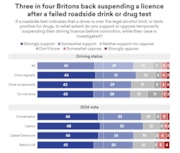
- 73 per cent support suspending a driver's licence before conviction after a failed roadside drink or drug test. Just six per cent are opposed.
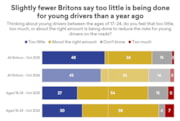
- 45 per cent say too little is being done to reduce the risks for young drivers, broadly in line with last year (48 per cent).
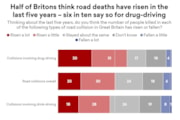
- Half of Britons think road deaths have risen over the last five years. Only seven per cent think they have fallen, though official figures show deaths have dropped slightly each year since 2022.
Ruth Purdie OBE, Chief Executive of The Road Safety Trust, said: “Progress on reducing the number of those killed or seriously injured on our roads has plateaued for too long, and the introduction of the Government’s Road Safety Strategy has been a welcome and important step towards a renewed focus on road safety at national level.
“These findings indicate an appetite for bold action and robust road safety measures which have the potential to save many lives on our roads. I hope it gives leaders the confidence that their decisions will be supported by a willing public.”
Louis O’Geran, External Affairs Manager at More in Common, said: “This research shows that the public are attuned to the dangers of driving on our roads – three in five correctly identified that drug-driving deaths have risen in recent years – and there’s an appetite for tough measures to improve road safety.
“Often, interventions on road safety risk being framed as a divisive ‘war on motorists’, and it’s too early to say how the government’s Road Safety Strategy will land with the public when it is implemented. But it’s clear from the data that a bold policy package on road safety could appeal across voter groups and age groups.”
Strong support for road safety measures
Key elements of the Government’s Road Safety Strategy are popular with the public.
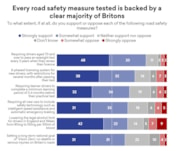
All six road safety measures tested received clear majority public support, including several proposals in the Government’s Road Safety Strategy.
Eyesight tests every three years for drivers aged 70 and over are the most popular (81 per cent support, six per cent oppose). Support holds among older people themselves: 85 per cent of those aged 75 and over back the policy.
Seven in ten (71 per cent) back a phased licensing system for new drivers, with restrictions such as limits on late-night driving or carrying young passengers. Two-thirds (66 per cent) support a minimum learning period of three to six months between the theory and practical tests.
Around six in ten back requiring safety technology, such as intelligent speed assistance, in all new cars (64 per cent), lowering the drink-drive limit in England and Wales from 80mg to 50mg (64 per cent), and a national 'Vision Zero' goal of no deaths or serious injuries on Britain's roads (62 per cent).
Support for these policies spans across voter groups. No measure falls below 57 per cent support among any group of 2024 voters.

Nearly half remain concerned that too little is being done to protect young drivers
Just under half of Britons (45 per cent) say too little is being done to reduce the risks for young drivers, broadly unchanged from 48 per cent in October 2025. Concern rises sharply with age: around two-thirds of over-65s say too little is being done, compared with 30 per cent of 18–24s.
Phased licensing shows the same split. Nine in ten over-75s (91 per cent) support it, compared with under half of 18–24s (49 per cent). A minimum learning period is less divisive, backed by six in ten (61 per cent) of 18–24s.

Strong support for greater action on drink and drug driving
Nearly three-quarters of Britons (73 per cent) support temporarily suspending a driver's licence before conviction if a roadside test shows they are over the alcohol limit or positive for drugs. Support is consistent among regular drivers (75 per cent) and non-drivers (70 per cent).
Around half (49 per cent) think new drivers who passed their test in the last two years should face a lower alcohol limit than other drivers. That rises to 54 per cent among 18–24s, the group most affected. A further 45 per cent want a lower limit for professional drivers while working.
Most think the current minimum bans for drug-driving are about right. But views are split on the five-year minimum ban for causing death by careless driving under the influence of drugs: 44 per cent say it is too short, against 43 per cent who say it is about right.

Most Britons are aware that drug-driving deaths are on the rise
Six in ten Britons (61 per cent) think drug-driving deaths have risen, and the official data from 2023 showed deaths linked to drug-impaired driving had more than doubled over the past decade, while data from 2025 showed that drug-driving offences had overtaken drink-driving for the first time.
More broadly, half of Britons (50 per cent) think the number of people killed on Britain's roads has risen over the past five years, and only seven per cent think it has fallen.

ENDS
Contact Information
The Road Safety Trust Media Team
media@roadsafetytrust.org.uk
Notes to editors
For interview requests, please email The Road Safety Trust at media@roadsafetytrust.org.uk or contact Communications Manager Will Harris on 07802 417518.
More in Common surveyed 2,088 GB adults online between 3 and 5 October 2026. Results are weighted by age and gender interlocked, region, 2024 general election vote, ethnicity and education. More in Common is a member of the British Polling Council and abides by its rules.
The research follows a first wave of polling for the Road Safety Trust conducted between 3 and 6 October 2025 (2,003 GB adults). The young drivers question used identical wording in both waves.
Rounding: In some cases, the reported totals in the text (for example, the total ‘support’ figures derived from adding up ‘strongly’ and ‘somewhat’ support) appear different to the broken-down figures visible in the graph. This is due to the reported totals being rounded to the nearest integer.
Please note: The hyperlinked data on deaths linked to drug-impaired driving, and to drug driving offences overtaking drink driving, are both from UK-wide data sources. However, the sample More in Common surveyed for this research is representative of Great Britain only and does not include Northern Ireland.
The Road Safety Trust is the UK’s largest independent grant-giving charity dedicated to achieving zero road deaths and serious injuries. Through its funding, the Trust has supported pioneering projects that create lasting change for all road users.
To date, the Trust has awarded over £12million in grants to 120 projects helping to fund innovative approaches to road safety. These have included groundbreaking research into intelligent road signage, AI-powered speed enforcement technology, and innovative changes to the post-crash emergency response.
By funding and sharing the knowledge of innovative projects and cutting-edge research, The Road Safety Trust is helping to shape a safer future for everyone who uses the UK’s roads.
Visit our website: https://www.roadsafetytrust.org.uk
Join the conversation: The Road Safety Trust | LinkedIn

Powered by Onclusive PR Manager © 2026